
Picture description at B1: structure, useful phrases and an example
8 min read
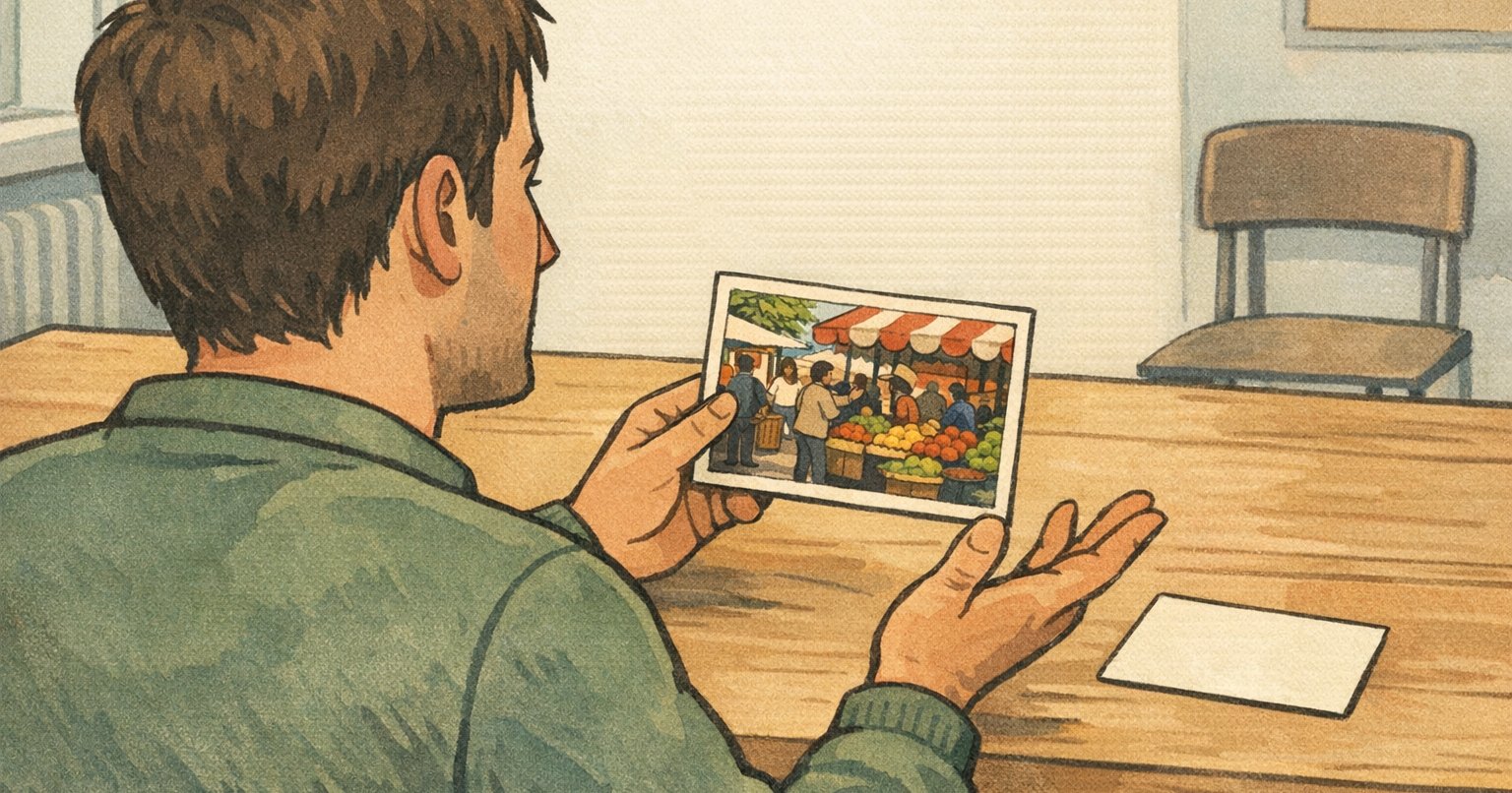
A picture description as a task in its own right exists only in the Deutsch-Test für Zuwanderer (DTZ, the German test for immigrants): in Part 2 of the speaking exam you are given a photo, say what you see and then talk about your own experiences. The Goethe-Zertifikat B1 and the telc Deutsch B1 contain no picture description — there you plan something together, present a topic or talk about opinions. Practising still pays off for everyone: if you can describe a photo fluently, you can also name places, people and situations when speaking freely.
Data checked: 21 October 2026. The sources are the Prüfungshandbuch (exam handbook) for the Deutsch-Test für Zuwanderer (Goethe-Institut and telc, 2009), DTZ practice set 1 from g.a.s.t. (June 2024), the Goethe-Zertifikat B1 implementation rules (as of 1 September 2025) with the practice set for adults, and practice test 1 for telc Deutsch B1 from telc gGmbH — check the current position with your provider before the exam.
Where does the picture description appear?
| Exam | Picture in the speaking part? | What is tested instead |
|---|---|---|
| Deutsch-Test für Zuwanderer | yes, Part 2 | describe a photo, then your own experiences and a comparison with your home country |
| Goethe-Zertifikat B1 | no | plan something together, present a topic, feedback and questions |
| telc Deutsch B1 | no | getting to know each other, talking about a topic (opinions), planning something together |
We describe the parts of the Goethe and telc exams in detail in The B1 speaking exam. Here the focus is on the DTZ task — and on the technique you need for any picture description.
How the DTZ part with the photo works
The DTZ speaking exam is a paired exam of approx. 16 minutes with five sub-tasks. Two of them matter for the picture description:
Part 2A — talking about experiences. Each person gets a different photo; the two pictures belong together thematically. In the practice set the task reads: „Sie haben in einer Zeitschrift ein Foto gefunden. Berichten Sie Ihrer Gesprächspartnerin oder Ihrem Gesprächspartner kurz: Was sehen Sie auf dem Foto? Was für eine Situation zeigt dieses Bild?“
Part 2B — responding to follow-up questions. Then the examiner asks, for example: „Erzählen Sie bitte: Welche Erfahrungen haben Sie damit?“ The follow-up questions often bring in your home country — „Wie ist das in Ihrem Heimatland?“
According to the exam handbook you speak for one to two minutes in Part A, and Parts A and B together last approx. three minutes per person. There is no preparation time and no aids are allowed; you may only look at the photo briefly, then you begin.
What the examiners want to hear
The DTZ assessment criteria distinguish precisely between B1 and A2:
| B1 | A2 | |
|---|---|---|
| Part 2A | name the main content of a photo and details too | name the main content briefly and very generally |
| Part 2B | report own experiences partly in detail | report own experiences briefly and generally |
So the difference between the levels is not grammar alone but the amount of detail. „Das ist ein Markt. Viele Leute.“ is A2. Saying which people are doing what, where they stand and what the mood is shows B1. On the assessment sheet of the practice set, Part 2A and Part 2B each count for up to 10 of 100 points; on top of that come pronunciation, fluency, accuracy and vocabulary, which are assessed across the whole conversation. B1 in speaking starts at 75 points — and without B1 in speaking there is no overall B1 result, as we explain in DTZ or B1?.
The structure: five steps that always work
- Overview — one sentence on the topic: „Auf dem Foto sieht man einen Wochenmarkt in einer Stadt.“
- People and place — who can be seen, where is it? „Im Vordergrund steht eine Verkäuferin hinter einem Stand mit Obst.“
- Details — what are the people doing, what is lying, standing or hanging where? Colours, clothing, weather.
- Guesses — what is happening right now, what is the mood? „Ich glaube, es ist Samstagvormittag.“
- Own experience or opinion — the bridge to Part 2B: „Ich selbst gehe auch gern auf den Markt, weil …“
Step 4 is the one many people forget. The task asks explicitly: „Was für eine Situation zeigt dieses Bild?“ — a mere list of objects does not answer that question.
Useful phrases for the picture description
Opening: Auf dem Foto sieht man … · Das Bild zeigt … · Hier geht es um …
Where? Im Vordergrund / Im Hintergrund · In der Mitte · Links / Rechts · Oben / Unten · Neben dem Stand · Hinter der Frau
What are the people doing? Ein Mann kauft gerade … · Zwei Kinder spielen … · Die Frau hält … in der Hand.
Guesses: Ich glaube, dass … · Ich vermute, … · Vielleicht … · Es sieht so aus, als ob … · Wahrscheinlich ist es …
Mood: Die Stimmung wirkt fröhlich / ruhig / hektisch. · Die Leute scheinen gute Laune zu haben.
Bridge to your own experience: Das erinnert mich an … · Bei mir ist das so: … · In meinem Heimatland ist das ähnlich / ganz anders, weil …
When describing places, watch out for the dative after two-way prepositions (Wechselpräpositionen): im Vordergrund, auf dem Tisch, neben der Kasse, hinter den Kisten — the question is always wo?, not wohin?.
Typical mistakes that cost points
- Just listing things. „Äpfel, Tomaten, Blumen, Leute.“ Without verbs and without sentences you show neither vocabulary nor grammar.
- Stopping too early. After three sentences the photo has not been described. Go through the five steps and the time fills itself.
- A guess stated as fact. „Die Frau ist Lehrerin.“ — how do you know that? Better: „Vielleicht ist sie Lehrerin, denn sie trägt viele Hefte.“ With a reason, a guess becomes a B1 sentence.
- Staying in the present tense when you narrate. In Part 2B you report on experiences — for that you need the Perfekt (present perfect): „Letzten Sommer bin ich mit meiner Tochter auf einen Flohmarkt gegangen.“
- Falling silent when a word is missing. Paraphrase: „So ein Ding, in dem man das Obst trägt“ — that is better than a pause.
An example
The photo (invented): a weekly market on a sunny day, a fruit stall at the front, people with bags behind it.
„Auf dem Foto sieht man einen Wochenmarkt in einer Stadt. Im Vordergrund steht eine Verkäuferin hinter einem Stand mit Obst und Gemüse. Sie trägt eine grüne Schürze und gibt einem älteren Mann eine Tüte mit Äpfeln. Links liegen Tomaten und Paprika in Holzkisten. Im Hintergrund sieht man viele Leute mit Einkaufstaschen, und rechts gibt es einen Stand mit Blumen. Der Himmel ist blau, deshalb glaube ich, dass es ein warmer Tag ist. Wahrscheinlich ist es Samstagvormittag, weil so viele Menschen einkaufen. Die Stimmung wirkt fröhlich und entspannt. Das Foto zeigt, wie Menschen am Wochenende frische Lebensmittel kaufen.“
And in answer to the question „Welche Erfahrungen haben Sie damit?“:
„Ich gehe fast jeden Samstag auf den Markt in meinem Stadtteil. Dort ist das Obst oft frischer als im Supermarkt, aber manchmal auch teurer. In meinem Heimatland war der Markt viel größer, und man hat über den Preis gesprochen. Das habe ich in Deutschland noch nie gesehen.“
Together that is a good two minutes of speaking time — with place, details, a guess, a reason, the Perfekt and a comparison. That is exactly what the B1 column of the assessment describes.
How to practise effectively
Picture description is a technique, and technique becomes secure through repetition. A plan for three weeks:
| Week | What you do |
|---|---|
| 1 | describe a photo from everyday life out loud every day, with the five steps on a slip of paper in front of you |
| 2 | without the slip, with a clock: speak for two minutes, then one minute about your own experiences in the Perfekt |
| 3 | with a partner: ask each other follow-up questions like the examiners in Part 2B |
Record yourself on your phone. When you listen back you notice at once where you hesitate and which words are missing.
On this site you can practise the picture description with AI assessment for free: you choose a photo, write or speak your description and get an assessment of task completion, grammar, vocabulary and fluency, plus a model answer to compare with. This is a training format with its own points scale — not the assessment of the real exam. For the presentation part of the Goethe-Zertifikat B1 there is also Monologue and presentation; you can practise the complete procedure in a practice pack in the format of the exam, and close grammar gaps such as the two-way prepositions in the German course.
What is binding is your provider’s task formats and assessment criteria in their current version. Our practice tasks are our own material in the format of the exam, not real exam papers.